Posted by Cocker-Weber Brush Company on | Comments Off on Disk Brush vs. Wheel Brush: Key Differences and Applications
Choosing the right brush for your production line isn’t just about spinning bristles. It affects finish quality, speed, and overall efficiency. Disk brushes and wheel brushes each serve specific purposes, and using the wrong one can cost time and money. Companies like Cocker‑Weber Brush Company have decades of experience producing both types, offering options for standard or custom industrial brushes as well as refurbished industrial brushes for cost-conscious operations. This guide will help you understand the differences and when to use each type.
What is a Disk Brush?
A disk brush is a flat, circular brush mounted on a spindle. Its bristles are arranged to make consistent contact with flat surfaces. Disk brushes are widely used for cleaning, polishing, deburring, and scrubbing.
Common applications:
Smoothing metal sheets after cutting or stamping.
Removing residues from flat surfaces in food processing or packaging lines.
Polishing and finishing surfaces that require consistent pressure.
Advantages:
Provides even contact over the surface.
Offers precise finish control.
Can be ordered as custom industrial brushes to fit your specific machines or surface requirements.
For operations that want to reduce costs, refurbished industrial brushes are an option.
What is a Wheel Brush?
A wheel brush looks like a spinning wheel attached to a shaft. The bristles radiate outward, making it ideal for working on edges, curves, or cylindrical objects. Wheel brushes handle surfaces that disk brushes cannot reach effectively.
Common applications:
Edge finishing and cleaning of rounded parts.
Polishing tools, molds, or metal rods.
Dental labs and precision manufacturing where contours are common.
Advantages:
Handles irregular surfaces better than disk brushes.
Can operate at high speeds for quick processing.
Available in custom industrial brushes or refurbished industrial brushes for specific shapes and tasks.
Many trusted manufacturers, including Cocker‑Weber, provide both standard and customized wheel brushes.
Key Differences Between Disk and Wheel Brushes
Design: Disk brushes are flat and uniform; wheel brushes are cylindrical and flexible for curves.
Applications: Disk brushes excel on flat surfaces; wheel brushes work on edges, contours, and cylindrical objects.
Performance: Disk brushes offer steady contact and finish, while wheel brushes provide versatility for irregular shapes.
Maintenance: Both can be cleaned, repaired, or replaced. Refurbished industrial brushes are available to extend brush life without the cost of new ones.
Choosing the Right Brush
Deciding between disk and wheel brushes comes down to surface type, material, and production needs. Consider:
Flat vs. curved or irregular surfaces.
Material being processed: metal, wood, plastic.
Speed of production and precision requirements.
Cost is another factor. Refurbished industrial brushes are often cheaper and perform reliably.
Get the Right Brush for Your Operation
Choosing the right brush can save time, reduce waste, and improve your product’s finish. Whether you need a disk brush for flat surfaces or a wheel brush for edges and curves, selecting the right tool matters. Consider custom industrial brushes or refurbished industrial brushes to match your specific requirements and budget.
We at Cocker‑Weber Brush Company offer reliable options that keep production running smoothly. Don’t compromise on quality-invest in the brushes that work for your surfaces and processes. Contact us today and find the perfect fit for your operation.
Posted by Cocker-Weber Brush Company on | Comments Off on How Industrial Cleaning Brushes Improve Equipment Performance
Optimizing equipment performance is a core priority across industrial environments, and contamination control is one of the most effective ways to support reliable operation. High-quality industrial cleaning brushes are essential tools for removing debris, residue, and process buildup from machinery, conveyor systems, and production equipment. Whether a facility uses cup brushes, wheel brushes, cylinder brushes, plate brushes, strip brushes, or horse hair brushes, maintaining these tools appropriately directly affects equipment performance, safety, and lifespan.
At Cocker-Weber Brush Company, we supply the full range of industrial cleaning brush types designed for demanding applications including cleaning, sorting, finishing, scrubbing, deburring, and contamination removal. Below are the primary reasons facilities should routinely replace worn brushes or choose high-quality refurbished or new brushes to protect their machinery and production output. Contact us today to learn more or arrange a purchase!
Reducing Wear and Tear
Quality industrial cleaning brushes play a crucial role in limiting mechanical wear. When debris, fines, and process residue accumulate on conveyor systems, bearings, housings, or other exposed components, they introduce friction, third-body abrasion, and uneven loading. Over time, this buildup accelerates component fatigue and increases the risk of early failure.
Using properly maintained cup brushes, cylinder brushes, and wheel brushes prevents material accumulation that restricts movement or adds frictional drag. Replacing worn or ineffective industrial cleaning brushes ensures consistent cleaning action and protects equipment surfaces from unnecessary mechanical stress.
Enhancing Equipment Efficiency
Clean equipment moves as designed, cycles as intended, and maintains predictable performance. Industrial cleaning brushes remove buildup that impairs rollers, blades, guides, conveyors, and sensors. When brushes wear down or lose filament integrity, their cleaning efficiency declines, allowing residue to accumulate and slow production.
Replacing or refurbishing plate brushes, strip brushes, and cylinder brushes restores full cleaning performance. This results in:
Faster production rates
Lower friction loads
More consistent throughput
Improved motion control
Higher quality equipment output
Products that depend on precise alignment, smooth transfer, or clean surface contact see immediate performance gains from properly maintained industrial cleaning brushes.
Cost Savings
Investing in high-quality, properly maintained industrial cleaning brushes delivers measurable cost savings across any facility. Routine brush replacement prevents unplanned downtime from contamination-related equipment failures, seized bearings, misaligned components, and overheating drives.
Well-maintained industrial cleaning brushes help facilities:
Avoid expensive emergency repairs
Extend the life of high-value equipment
Reduce energy consumption by minimizing friction
Lower scrap and waste caused by contamination
Prevent costly shutdowns and restarts
Choosing new or professionally refurbished brushes ensures consistent bristle integrity, uniform cleaning force, and full restoration of the brush’s original performance characteristics.
Enhanced Safety
Clean equipment is inherently safer equipment. Industrial cleaning brushes remove debris that contributes to mechanical binding, inconsistent movement, or unexpected equipment behavior. Worn brushes that no longer reach critical surfaces allow dust and residue to accumulate in areas that can create hazards.
Properly maintained brushes reduce:
Heat buildup on motors and electrical housings
Dust accumulation that can cause arcing or ignition
Obstructions that interfere with machine guards or sensors
Contaminants that affect operator visibility or access points
Replacing degraded brushes helps maintain the safety envelope of the machinery, supports regulatory compliance, and promotes a safer work environment for operators and maintenance personnel.
Preventing Equipment Failures
Industrial cleaning brushes are a first line of defense against the failure modes caused by residue and contamination. Even small accumulations can affect conveyor tracking, drive-system torque, blade alignment, pneumatic systems, and thermal performance.
Routine replacement or refurbishment of industrial cleaning brushes ensures that bristle stiffness, uniformity, and coverage remain at design specifications. This prevents particles from reaching failure-critical areas, such as:
Bearings and bushings
Optic or electronic sensors
Electrical enclosures
High-friction interfaces
Rotating assemblies
Well-maintained brushes keep equipment in stable operating condition and reduce the frequency of breakdowns.
Enhancing Product Quality
Clean machinery produces consistent, high-quality output. In industries with strict hygiene or precision requirements such as food processing, pharmaceuticals, packaging, and electronics assembly, contamination control is non-negotiable. Industrial cleaning brushes reach difficult surfaces where manual cleaning is impractical or inconsistent.
Replacing worn horse hair brushes, strip brushes, cup brushes, and wheel brushes maintains the surface integrity needed to avoid particle contamination, cross-contamination, or surface defects. For high-spec applications, brush condition directly influences product quality and regulatory compliance.
Choosing the Ideal Industrial Cleaning Brushes
Selecting and maintaining the right industrial cleaning brush is essential for maximizing equipment performance. Brush selection should consider:
Application type (cleaning, conveying, deburring, finishing, sorting)
Bristle material (synthetic, natural, abrasive, metal)
Operating environment (temperature, chemical exposure, humidity)
Required cleaning force and filament durability
Replacing brushes at appropriate intervals ensures consistent cleaning force and protects machinery from contamination-related stress.
At Cocker-Weber Brush Company, we provide new, replacement, and high-quality refurbished industrial brushes designed to meet demanding mechanical, thermal, and contamination-control requirements. Contact us today for help choosing the ideal brushes to keep your industrial equipment in great shape!
Posted by Cocker-Weber Brush Company on | Comments Off on A Complete Guide to Custom Industrial Brushes: Materials, Shapes & Uses
Custom industrial brushes are essential tools across a range of industries. From removing debris to polishing delicate components, these brushes serve critical functions. Off-the-shelf options work for some applications, but many operations require brushes made to match specific dimensions, environments, or processes. This is where custom industrial brushes offer value.
Cocker-Weber Brush Company has supplied American-made brushes for over a century, producing solutions for manufacturers, packaging facilities, laboratories, and more. Each brush is built with precision and durability in mind.
What Are Custom Industrial Brushes?
Custom industrial brushes are created to exact specifications. That includes choosing the bristle material, brush shape, trim length, bristle density, and mounting options. Some jobs call for brushes that fit into tight or irregular spaces. Others need a certain filament stiffness or resistance to heat, solvents, or abrasion. In these cases, customized brushes allow for optimal performance where standard brushes fall short.
Cocker-Weber makes it easy to match the brush to the job. Customers can submit drawings or describe their application, and the team will review all requirements—including brush shape, construction method, bristle material, filament length, core diameter, and arbor hole size. Every brush is produced in-house for quality and consistency. We also offer refurbishment services, helping extend the life of existing brush cores.
Applications include cleaning conveyor belts, prepping surfaces for coatings, static control, and product sorting.
Brush Shapes: Cylinder, Disk, and Wheel
The shape of a brush affects its function. Below are three of the most commonly requested types:
Cylinder Brush
A cylinder brush is a versatile design featuring bristles mounted around a central core. These brushes can be configured with straight rows, spiral patterns, or herringbone arrangements depending on the application. They are widely used for sweeping, scrubbing, spreading, or cleaning continuous surfaces—such as in conveyor systems, bottling lines, or sheet material processing. The row arrangement, filament type, and brush diameter all influence how the brush performs in specific environments.
Disk Brush
Disk brushes are circular and flat, with bristles radiating outward from the center. They’re used for polishing, light sanding, static dissipation, and precision cleaning. The brush face can be adjusted for diameter, hole size, and bristle density. Disk brushes often rotate horizontally and make contact with surfaces from above or below, depending on the setup.
Wheel Brush
A wheel brush features radial bristle alignment around a rotating hub. These brushes are often found in surface prep, weld cleaning, paint removal, or rust stripping operations. They can be aggressive or soft, depending on the chosen bristle material. Wheel brushes are mounted on grinders, drills, or automated machines.
Each of these brush styles can be made with natural or synthetic bristles, and can be constructed using staple-set, drawn-in-wire, or epoxy-set methods.
Materials Used
The performance of a brush depends on its materials. Cocker-Weber offers a wide range of options, including:
Natural fibers such as Chungking bristle, horsehair, tampico, and goat hair for fine polishing and non-abrasive cleaning.
Synthetic filaments like nylon, polypropylene, and abrasive-filled plastics are used for general cleaning, durability, and moisture resistance.
Metal wires including carbon steel, stainless steel, brass, and bronze, for heavy-duty tasks like rust removal or pipe cleaning.
Cores can be made from wood, plastic, steel, or aluminum, depending on strength and environmental needs.
Get Started
To request a quote or begin the custom brush process, contact Cocker-Weber Brush today. Whether you need a cylinder brush for conveyor systems, a disk brush for polishing, or a wheel brush for surface prep, Cocker-Weber is a trusted partner in custom brush manufacturing.
Posted by Cocker-Weber Brush Company on | Comments Off on Revealing the Potential of Glass Brushes
Click to Expand
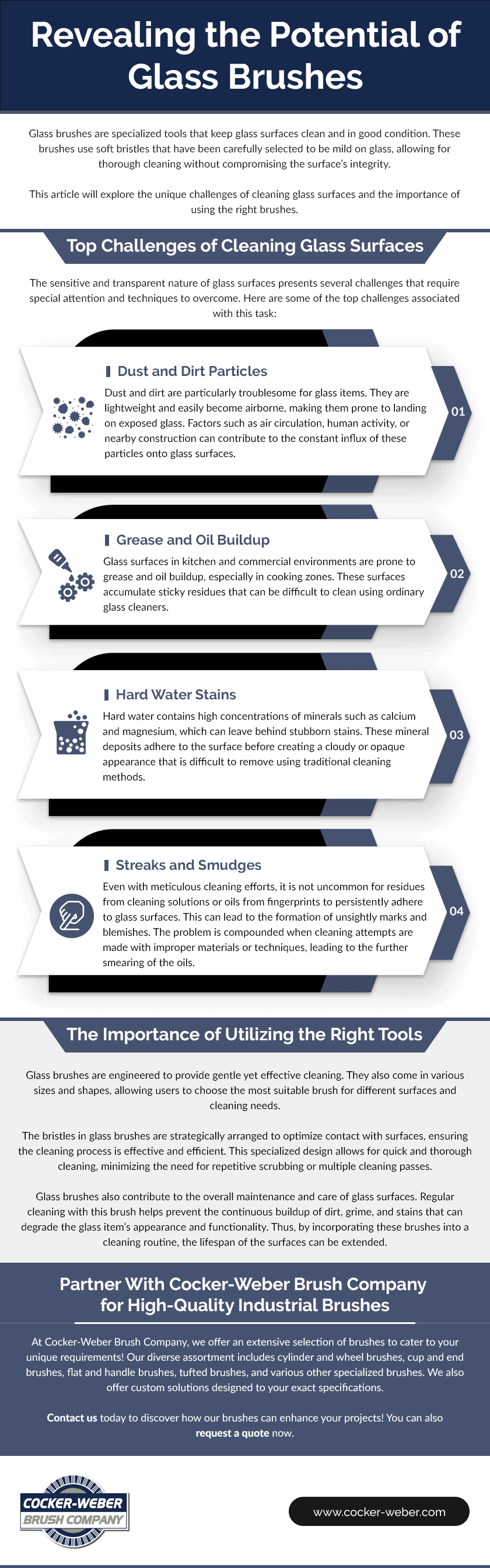
Glass brushes are specialized tools that keep glass surfaces clean and in good condition. These brushes use soft bristles that have been carefully selected to be mild on glass, allowing for thorough cleaning without compromising the surface’s integrity.
This article will explore the unique challenges of cleaning glass surfaces and the importance of using the right brushes.
Top Challenges of Cleaning Glass Surfaces
The sensitive and transparent nature of glass surfaces presents several challenges that require special attention and techniques to overcome. Here are some of the top challenges associated with this task:
Dust and Dirt Particles
Dust and dirt are particularly troublesome for glass items. They are lightweight and easily become airborne, making them prone to landing on exposed glass. Factors such as air circulation, human activity, or nearby construction can contribute to the constant influx of these particles onto glass surfaces.
Grease and Oil Buildup
Glass surfaces in kitchen and commercial environments are prone to grease and oil buildup, especially in cooking zones. These surfaces accumulate sticky residues that can be difficult to clean using ordinary glass cleaners.
Hard Water Stains
Hard water contains high concentrations of minerals such as calcium and magnesium, which can leave behind stubborn stains. These mineral deposits adhere to the surface before creating a cloudy or opaque appearance that is difficult to remove using traditional cleaning methods.
Streaks and Smudges
Even with meticulous cleaning efforts, it is not uncommon for residues from cleaning solutions or oils from fingerprints to persistently adhere to glass surfaces. This can lead to the formation of unsightly marks and blemishes. The problem is compounded when cleaning attempts are made with improper materials or techniques, leading to the further smearing of the oils.
The Importance of Utilizing the Right Tools
Glass brushes are engineered to provide gentle yet effective cleaning. They also come in various sizes and shapes, allowing users to choose the most suitable brush for different surfaces and cleaning needs.
The bristles in glass brushes are strategically arranged to optimize contact with surfaces, ensuring the cleaning process is effective and efficient. This specialized design allows for quick and thorough cleaning, minimizing the need for repetitive scrubbing or multiple cleaning passes.
Glass brushes also contribute to the overall maintenance and care of glass surfaces. Regular cleaning with this brush helps prevent the continuous buildup of dirt, grime, and stains that can degrade the glass item’s appearance and functionality. Thus, by incorporating these brushes into a cleaning routine, the lifespan of the surfaces can be extended.
Partner With Cocker-Weber Brush Company for High-Quality Industrial Brushes
At Cocker-Weber Brush Company, we offer an extensive selection of brushes to cater to your unique requirements! Our diverse assortment includes cylinder and wheel brushes, cup and end brushes, flat and handle brushes, tufted brushes, and various other specialized brushes. We also offer custom solutions designed to your exact specifications.
Contact us today to discover how our brushes can enhance your projects! You can also request a quote now.